First, fast, furious...Bangladeshi business blog

We provide
--social media strategies for Bangladeshi businesses worldwide
--public speaking on Bangladeshi businesses and social media
--paid product/service/website reviews of Bangladeshi companies

Interested to place an advertisement for your business?

Sunday, November 15, 2009

Learning English the BBC Janala way

The need for being multi-lingual to gain an edge in the global business stage has been mentioned in this blog before. Its good to see some signs of innovative teaching mechanisms to spread the language learning drive. This time its BBC who has come up with a bi-lingual website to help learners of the English language in Bangladesh to take lessons over internet, mobile phones etc. Read here to know more.


Some initiative is better than no initiative at all, so hats off to BBC Trust for thinking how relevant digital technologies in the Bangladeshi context can be applied to provide language education. Some constructive observations and feedback though.


1. I think its important to segment and identify the learning audience. When you arrive at the website at http://www.bbcjanala.com, there is no clear navigation to identify myself with any learning group. For example, say I am a housewife, kid (minor), graduate, business executive, businessman (or woman) etc. Users online would like to identify themselves with any of the services being offered, as every user's needs are unique. So BBC Janala could look into the issue of segmenting the audience and tailor made their language courses accordingly. It is expected that the English learning needs of a housewife might be different from those of a business executive who encounters English speaking people almost everyday. So 'English for housewives' and 'English for businesspeople' can be packaged to cater to two different groups.


2. It might be a possibility that this service is promoted in the rural areas through various telecenters spread around Bangladesh. Since they are working with Grameen Phone (along with all other telecom operators) any ways in this project, might be possible to promote the service through the Grameen Phone Community Information Centers (GPCIC).


3. The fact that the lessons can be listened to through mobile phone sounds good but the cost associated with it (3 taka for a 3 minute audio lesson) still remains a bit high in my perspective. No doubt that the service shall never be free. But at the same time, we need to keep in mind that the vacuum the service is trying to fill is a failure of the overall education system of Bangladesh which somehow does not take into realistic consideration the need to be able to converse in fluent English (also not other languages). Also, if someone just decides to call up a friend or a person who happens to possess better knowledge of English then the whole point of having these lessons available through airtime becomes less useful. In my opinion, I really don't envisage many people to call up this service spending 3 taka for 3 minutes just to know English from perhaps an automated machine response, so better need to look at the alternatives available and how to make this service exclusive.


4. Finally its very important to demonstrate and make explicit references to real stories of real people on how knowing English aided someone in their personal, professional lives. Unless I know why or how or when exactly learning English will provide me visible benefits, chances are that I would still remain a bit doubtful in becoming a loyal and long term user of the BBC Janala service.

Wednesday, November 4, 2009

Effective Bangladeshi Diaspora network for economic transformation of Bangladesh (The Diaspora Project)

The Bangladesh Enterprise Institute (BEI) in Partnership with the Asian Tiger Capital Partners (AT Capital) has initiated a year long project on establishing an effective Bangladeshi Diaspora network for economic transformation of Bangladesh (The Diaspora Project). The project purpose is ‘To identify the impact of Bangladeshi Diaspora in Economic transformation and leveraging its Diaspora in terms of knowledge and skills transfers and improving its global commercial interface. To establish an effective Diaspora Knowledge Network (DKN) of the British Citizen with Bangladeshi origins.’ The DKN aims to provide various online tools which will: (click read more)

• Help the non-resident Bangladeshis (NRBs) to source and identify the skills and expertise they need from the network;
• Facilitate online communications with other NRBs globally; Submit proposals / issues which other NRBs can contribute and assist, depending on their level of skills and interest;
• Promote successful NRBs on a monthly basis from the network and provide a short profile on the website; and
• Leverage on the NRB network by sharing consultancy projects and other issues in Bangladesh that requires professionals’ advice and guidance which can be received from the vast knowledge network.

Seems to be a good initiative to channel back the good experiences, expertise gathered on foreign soil back to the roots. You can download the form to join from here, download Mr. Ifty's presentation here and the strategy document here.


I attended one of these events in London last week arranged by the bobNetwork and I was priveleged enough to have taken a short phone interview of Mr. Ifty Islam earlier today. He was asked the following questions and you can hear more about his views in the embedded phonecast.

1. Why do you think NRBs have a role to play in investment opportunities in Bangladesh?
2. What are the exact ways (how exactly) can they do it?
3. Is the role same for all NRBs in all countries or NRBs in some countries have more role to play than those in others?
4. What are the key challenges in Bangladesh now hindering the contribution and involvement of NRBs?
5. Please tell something about your partnership on this project with BEI.
6. What is your opinion on country marketing, do you have any plans for that to promote this project sustainably over the next few years?


Also have a look at his views on the financial sector of Bangladesh here

We hail this effort at the Bangladesh Corporate Blog and express our intentions to spread the word of mouse and word of mouth to make this venture bear fruit for Bangladesh.
.

image: http://purpleonline.net/June09/CoverStory/1/1.jpg

Tuesday, November 3, 2009

Beggars can be choosers, in Dhaka atleast

So you must be knowing about Sports Zone in Mohakhali, Export Processing Zones (EPZ) outside Dhaka and Chittagong, the diplomatic zone in Baridhara, you have also heard about O-zone (that is Ozone layer in the atmosphere) and some of you might be ardent fans of Boy Zone too....but now lets give it up for the new 'zone' in town...yet another product of some creative brains in the national administration...in the form of nothing other than our very own and only 'begging zone' for the Dhaka city! Yes, I am also wondering like you whether to laugh, cry, frown or sigh at this, can't make up my mind yet.


Read more here to find out how the government's Disabled Welfare Foundation had outlined an action plan to rehabilitate beggars so that "they can't create nuisances or tarnish the country's image". A survey is planned led by a 'top TV star' and charities are also pretty much vocal on the roots and reasons of why there is a huge influx of beggars in the capital. Honestly, I don't see how effective this 'special zone' would be to reduce the miseries of these beggars, some of them are 'happy-go-lucky beggars' any ways and have decided to join this 'business' voluntarily or due to family traditions. Now for the real victims of natural calamities, acute poverty...it needs a greater planning to re-establish them in the society, or to convert them long term into some sort of a workforce. Following the principles of cause and effect, we always come up with knee jerk reactions and 'measures' to prevent the 'effects' and the by-products, comfortably procrastinating to remedy the root causes that cause the eventual not-so-good effects i.e. floods of beggars in this case.


I wonder how this special begging zone would be. Some questions begging to be answered are...
1. Will there be any physical boundary to demarcate this zone?
2. Which areas are likely to be labelled as this unfortunate zone?
3. How the residents of that area would feel? Would they be termed as beggars too?
4. Will the property prices go down/up in that special zone?
5. What kind of nuisances would the beggars be allowed to create inside this zone? Please give examples.
6. Can someone apply to become a beggar and get some sort of a permit to start begging in that zone?
7. Will the government introduce similar schemes especially right after Eid holidays when non-Dhakaiyyas go to their native district towns/villages? From now on, those who were born out of the capital would require special 'zone permits' (visas?) to stay, work, live inside the 'zoned' Dhaka city? Who knows the administration might think such fantasy schemes would help reduce the traffic jam and over population of Dhaka city. So rather than addressing the problems at the root, they might do some stunt here too.


I have heard that there had been some 'begging businessmen' who had been begging professionally for decades around the religious hotspots in Dhaka and are proud owners of multi-story flats in the capital. I used to confront the seriously out of rhythm 'sufi begging tunes' of a band of five beggars beside the Australian High Commission in Gulshan-2. Then there was the young ones who used to follow a 'trick or treat' approach in the traffic intersections. They used to assume how long-lasting your relationship will be if you happen to be sitting with your wife/girlfriend in the CNG (auto-rickshaw) and give you blessings, provided you pay some quick cash. Failure to do so sometimes followed with abuse too from safer distances. Personally I always avoided the too young and mischievious ones, the young, single moms with new borns who refused offers of working at home as maids or in any garments company. Not to mention the yearly fracas that takes place on the day of Eid ul Azha with women, children fighting over the 'third portion' of the meat and eventually reselling it and reselling it and reselling it. So much so for religious purpose. I preferred to pay some extra to the old rickshaw puller or to the ferry-wallahs who turned sweat to money everyday to meet their minimum living needs.


Certainly the act of begging is not something to be ridiculed, rather the reactions to tackle this problem is worthy of serious scrutiny and sarcasm. Like many other important problems of governance, this issue was never thought of. I hope whatever we plan now lasts beyond 5 years. A troika partnership among NGOs, private sector and government agencies is a must. Also we need to keep in mind that we as a nation has a tendency to go 'palms up' especially to donors and foreign aid agencies. That certainly trickles down to bottom, so we need to weed out those who prefer to beg just because its easy, requires no or little 'hardwork' and because the government is providing 'free zones' for them to beg and continue their trade.

image: http://www.google.com/hostednews/afp/slideshow/ALeqM5iM-F0yAxo2d5pknoNKAw-t7O7Z8g?index=0


Monday, November 2, 2009

What are you smiling for?

I would admit that when I walked into the Banani branch of Standard Chartered Bank in Dhaka, I was not expecting that the lady at the reception would smile and greet me in. As a reflex I also did smile back, quickly lost eye contact and moved on to fill up the pink slips, still thinking in the back of my mind, 'why did she smile at me? Am I looking funny? Does she know me? Do I know her? Have I seen her before somewhere? Which mela? Which mall? Pink City? Bashundhara Mall?'
Nevermind....I noticed slyly if she was extending the same smiling service to all customers who walked in or was I special, or was she suspicious? My brief 'participant observation' established the fact that she was naturally and willingly smiling at almost every customer walking in, depending on her preoccupations from time to time at her workstation. On the other hand, I tried to notice how the 'smile struck' customers were reacting to this smiling receptionist. Majority of the customers who walked in during my half an hour stay were male, students, business men, young and middle-aged men mostly. Other than a handful of them, most of the king customers either remained indifferent or just pretended as if she did not exist in that side of the room. However almost all of them, like me, didn't forget to throw a sly glance at her from different corners of the office space...probably posing the same questions as I did..trying to figure out the mystery of an unknown Bangladeshi woman smiling at unknown men, who she could be, what could be her family background etc. and all those unquenched curiosity, never realising just simply that its the very basic a staff at reception can do....smile, which does not cost anything...every company in the world asks, trains, teaches, preaches their staff to do this...at their customers....but many of them just forget to do it...or just don't do it because of some peculiarities on ground.


Female staff are deliberately kept at receptions not only in Bangladesh but around the world for variety of reasons. Having a sexist discussion would be something to discuss in a different post perhaps, but it is argued that you don't see many female staff smiling at you 'for nothing' when you walk towards the reception at any office premises in Bangladesh. Most of the time I have found staff at reception, both male and female, rather indifferent, cold, uninterested towards whoever is walking in to them. Many times, female staff are not very interested to make eye contacts too...perhaps wary of me smiling at her 'for nothing' :). Well I have heard arguments from both sides on this. Men say that many female staff think that they nearly were crowned Miss World in last year's beauty pageant but due to a twist in fate, they ended up at the wrong place of doing this job at the front desk or at the bank counters. Many also claim that some female executives carry the notion that some male customers might fall in love at first sight if they prefer to smile, act nice and easy with all of them. So to pre-empt and fend off any unsolicited advancement, the female cadre prefer to remain cold and appear as much formal, emotionless as possible.

Female staff on the other hand also argue that due to some peculiar perceptions towards women at work place in Bangladesh, most of the male customers, even colleagues are not 'properly' oriented with how to deal with female staff, colleagues etc. So many of the male customers, colleagues, who sometimes happen to be 'part time losers and lovers in their own right', try to express overflowing emotions of interest, mating and dating in the very first or few instances of receiving so called 'hints' from their female counterparts in the form of smiles, eye contact, showing signs of being comfortable etc. Women at workplace even in developed economies carry an extra burden of consciousness and identity, its no exception in Bangladesh, infact they perhaps carry a heavier load in that respect. However all these are mere hearsays which brings us to ask if there exists or not any research on 'gender issues while providing customer services' in Bangladesh..may be I will ask Parveen Apa.


Have a look at this article which I came across recently which discusses how women can crack the gender code at work place. Its a pretty interesting piece of work where highlights include when the author recommends women to 'dress for success, not for access' at work place (LOL)...also contradictory to what I have been trying to say in this blogpost...the author however advises working women 'not to smile too much' at work place. Not sure if you would agree with all this or not, but its worth giving a thought.


In fine, I think some men at work should realise that there is a right place for everything and every thoughts in the back of the mind...professional environment is perhaps best suited for work related issues only...so better take a casual 'professional' smile as its supposed to be. On the other hand...some women at work better accept the fact that not all approaching men wear dodgy looks and creepy personalities...so its advised to ease up. In the end of the day, it all falls on how one carries oneself...a 'smile' is harmless enough to cause any major trouble...but powerful enough to create that first link of 'putting at ease' with the customer. So smile, smile back and move on. :)))))))))))))))))))))


Image: That is a 'ficture' of a 'bideshi issmiling afa' taken from here

Monday, October 26, 2009

Bangladeshi owned Indian Restaurants in the UK : a brand crying for renaming


I think its high time we stop hiring bigger country labels from the neighbourhood to promote our businesses, which has been built up over the last few decades by our very own sweat, tears and hardwork…all in the shape of the £4 billion curry industry in Britain. Read here to find out how Bangladeshi businessmen brought the British curry industry to where it is today. Also, please read the latest news article here to find out about potential ‘revenue avenues’ we could reap from this industry.
However amidst all this merrymaking, my thoughts lie elsewhere. I ask myself,

1. Would this industry be in its present place if it were without the bold and brazen ‘brand India’ label sitting proudly on the signboards outside those 12000+ restaurants?
2. Now that the contribution of British-Bangladeshis to the UK economy is getting noticed and acknowledged day by day, can we risk stripping off the hired country brand from those signboards? Will this have any negative impact on the brand loyalty, brand perception etc. for those resturants?

Some scattered incidents, trying to relate them somehow.

You will get to see only a few restaurants in the UK which proudly claims in its exterior that it serves ‘Bangladeshi cuisine’, notably Kolapata in Whitechapel is one of the very few and some others in Bricklane. Ofcourse they don’t serve any Indian (North Indian to be more precise) food there and what they serve is much closer to what we actually eat in Bangladesh. Now its also true that we eat a lot of North Indian food too in our day to day occasions, but when it comes to doing food business overseas, are we letting go an opportunity to uphold the country’s brand (Bangladesh that is) or we are rightly giving the due credit to the actual originator of the food (India), even though the lion’s share of the business are held by Bangladeshis? I don’t know. Please also note that the report in bdnews24.com successfully and tactfully avoids the term ‘India’ or ‘Indian restaurants’.


My colleague once shared a ‘bitter’ experience he once had during his trip to Delhi a few years ago. In a bustling South Delhi restaurant, he once asked the waiter to bring in a ‘balti cuisine’, much to the confusion and uncertainty of the young Indian waiter who had no freaking clue what the white (nearly pink), fat, grey-haired British man was willing to eat. He explained meticulously that it’s that special type of pot in which he used to get served Chicken Tikka Masala in the Indian restaurant in Finchley Road in North London! He was also rather embarrassed thinking of any potential cultural gaffe he could have committed. The waiter remained indifferent to ‘balti’, thinking of how the shower tool ended up on the bewakoof gorey’s table in London. He could however receive well the Chicken Tikka Masala bit and moved on to serve him that, ofcourse not in any ‘balti’ or ‘bodna’ (no Wikipedia entry for ‘bodna’ yet) but on a simple brass made plate.


Moral of the story is, what they eat in North India is not actually what is served generally in the Bangladeshi owned Indian restaurants. Its somehow a mix of whatever that is, a best effort perhaps. It could be because of the fact that none of the chefs or their ancestors were born in or hail from North India, rather they are from the Golden Bengal, from the coast of the mighty Meghna, Surma, Kushiara..United Kingdom of Sylhet that is. Now whether they claim themselves to be Silotis first and foremost and are different from Bangalees/Bangladeshis would require a different blog post from this end. Its very likely they, like you and me, have been fed and bred on a lot of rice, fish, bhorta, dal, shatkora etc. and not on chapati, roti, and the curry-vaganza every day. Nevertheless, these businessmen have certainly brought about a revolution to the curry industry in the UK with their hardwork. Its good that the British government appreciates this fact, but I am sure that the British-Bangladeshi chefs don’t recceive any formal ‘thank you’ from the Indian High Commission in the UK or the diaspora, as other than ensuring a livelihood for themselves, they have ended up pumping up a different country’s brand muscle in the end of the day. I have come across a few Indian restaurants trying to woo European customers claiming that they ‘are not fake Indian restaurants (restaurants owned by Bangladeshis claiming to be serving Indian food) and they serve true Indian food…the taste of India!’. Now what do you say to that?


Amidst all this mud-throwing…balti-throwing etc. between country brand names, I think we should not spoil the food, or let it go cold and stale. In my opinion, the time is here to call a spade a spade. What would possibly go wrong if 12000+ Bangladeshi owned ‘Indian’ restaurants in the UK would decide to put the name of the red and green on the face of their businesses? Food fanatics can go fasting unto death that that food is not actually ‘Bangladeshi then’, but aren’t we in a good position to override those facts and establish the brand Bangladesh on 12000+ physical establishments in the UK? You call it a brand hijack or whatever, I am still all up for it. If the Bangladeshi businessmen were the first ones to have taught the British how to taste curry (Indian curry that is), then I am sure they can be frontiers to treat the British tastebuds to something more authentic, genuine, unique and truly ours….a dose not of dosa…but that of bhorta, dal, bhaat and the likes. Gelam. Khida lege gese.

Sunday, October 18, 2009

New TV Channels for Bangladeshi media...what about businesses?


Congratulations! We have 10 more new TV channels vying for some space in our television sets and living rooms. Check out the list here to find out what these new channels are called and who the 'visionaries' are behind setting up these.
Personally I have got over those days when we used to follow McGyver or Ayomoy or any other Humayun Ahmed drama serials in the Bangladesh Tele Vision (BTV), as we as viewers did not have any other choice. Until the day when satellite TV made its entry and till now when we have a plethora of TV channels springing up, imagine how fragmented our attention has become and how shorter our attention span is becoming day by day. How many programs you actually follow in one or more Bangladeshi channels these days which is sticky enough to make you come back and follow it week after week? Ofcourse I am not against allowing newer TV channels to come up, its just that the trend shows the genre of people who are setting these up, what their agenda might be in future and the audience they are going to target soon with their broadcasting prowess.


Its all either ruling party or opposition politicians, controversial businessmen who have cases of corruption and political affiliations against them or religious opinion leaders who have the required money and the contacts to come up with new TV channels. It reflects the general interest of viewership of our audience perhaps, or the intention of those who are in power and who hold the money to influence that viewership. So we get to watch a lot of political talk shows, religious shows and a whole range of drama serials pretty much based on same plots and banalities.


What is still missing from this rising trend of TV channels is undoubtedly any dedicated source of information, edutainment and infotainment based on business topics of Bangladesh. Wonder if its too early to dream of a TV channel promoting Bangladeshi business issues, entrepreneurship, innovation, achievements, skills development shows, company profiles, business debates, corporate culture shows, interviews of business champions, entrepreneurs etc. Is it too early to ask for a special focus on Bangladeshi corporates and brands in the form of a full fledged TV channel? With half of the population full of young and would be business leaders and entrepreneurs, do you think there is no market for such a channel?

Its common knowledge that the media of a country plays a pivotal role in shaping up the national psyche of a nation. First and foremost emphasis on politics, religion and entertainment only are required ofcourse to fill up the whole gamut of services, however, I wonder why Bangladesh corporate would be deemed so negligible so as not to deserve any attention in terms of a specialised media channel? Its imperative that we make use of the media (traditional and new) to raise awareness of our business topics, brands, culture, challenges and opportunities and make it cross the border please.

Thursday, October 15, 2009

Would David Rowe get a job in Bangladesh?


Some claimed that economic recession was the best time for innovation, to have a fresh look at things, new ways of doing old stuff. Now that included the way you used to hunt for jobs too. With so many people losing jobs everyday across the western world, many still thought to be innovative in the way they go about looking for a suitable career in these times of uncertainty. David Rowe, a graduate of University of Kent, pulled out a publicity stunt for himself by posing as a mobile billboard seeking a job in the busy streets of London. He was even offering would be employers free employment for the first month so that they could ‘try’ him before paying or firing him. Times are hard and so are getting jobs.


However, his stunt seemed to have paid off finally as he has recently been landed a job at JCDecaux, one of the largest outdoor ad companies of the world, after the Managing Director of the company spotted him in the street ‘self-advertising’ for a job. The angelic MD thought that the way David had promoted and branded himself against all odds, taking advantage of the right context and right times (recession) was unique and innovative. He believes that David could be a good asset for his company as he has innovative advertising skills. So far so good for David.


Remember warning signs in some stunt related TV serials which says ‘Don’t try this at home!!’? I wonder if any desperate souls ever try this at Mohakhali flyover or in the busy streets of Motijheel, what the reaction would be? We are a curious nation by birth…we gather around any gathering even if all might be gazing at vaccum, or a Sony TV showroom or anything unusual in the streets of Dhaka. So if someone ever attempts similar stunts in the quest to look for a job, rest assured there would be a good number of curious onlookers, passersby, sympathisers around him (or her?). Who knows such an act might incite the likes of Munni Saha and gang to show up for a spot interview or some media frenzy. So if a suit wearing job hunter ever does this in Dhaka, what are the chances that he actually might end up getting a dream job (forget about dreams, any job would do under those circumstances)? I don’t know really, it can go either way, given the Hujug Nation as we are, he might become the next best thing in Bangladeshi media for a while. However, for a female jobhunter, I don’t think this stunt might be useful in the context of Bangladesh. Since we are also a nation of Google Memory when it comes to tracing back the ins and outs of every women in limelight, such a stunt by a jobhuntress would have detrimental effects for her in society (for future marriage proposals etc.). Pun intended.


In the end of the day, I hope we don’t even have to think about going to such extremes. So much of time, money from parents have been dedicated to get ourselves education, all for the sake of earning a decent bread and butter and for living with dignity. However, the take away from David Rowe’s stunt remains…that even during crisis, don’t let go your sense of creativity, innovation, uniqueness, determination and self-branding. Good luck always with your job hunts. Hope we don't have to do a David Rowe in the streets of Dhaka.

Sunday, October 11, 2009

The Role of Stock Recommendation

I wonder how we can get together and work for common purpose to improve many things that we do for living, obliviously we would come up with millions of things are not going right comparing to developed countries. Many dreams are never formed but thrown away to the air as soon as hopes are never seen lightened in our lives. Developments, progress and achievements are rarely seen here compare to many other countries where every five years you will not recognize the place due to economic growth, developments and implementing new systems. It's all about changing, and work together for continuous improvements. Before changing anything to outer-world we need to change our minds and attitudes toward progress, changes have to come within ourselves and apply inside to outside environment, and also firm believer in order to see greater affect and progress in what we do for living.


I know you are confused with changes and stock recommendation, but let me share partly one of letters with you that was sent out to brokerage/financial firms in Bangladesh in the month of Ramadan to engage them into stock recommendation process, and of course, the intention of this is to work together in the direction of setting Bangladesh Stock Market to systematic market system and attracting more professional analysts into analyzing companies in order to provide recommendations.such great works can be rewarded with performance-based approach. Market needs professional analysts' involvement in order to uphold the image of Bangladesh stock market. Here is a letter--


"So far, over 800 people registered with www.bdstock.com within last three months of period and most of them have showed great interest of receiving recommendation in the process of registration. They are eager to receiving some guidance in the selection of specific companies' share which perceive greater value based on out-perform/market-perform, great earnings, performance-based management, etc. or opposite of all these to sell stocks.


How much investors depend on analysts' report? Probably more than what you expect because either a person is a beginner or a pro as an investor. And people around the world always rely on a whole set of decision making processes to pick the best stocks. This decision making task is a part of a daily process for market analysts in order to select a list of good stocks. The analysts conduct extensive research on companies' annual reports, corporate governance, management behavior & expertise, company's competitive advantages, new contracts for selling products, new deals, company news, innovative new ideas and so many others. A good analyst report should serve the purpose of better understanding the status of a company's growth to justify if a company's outlook is positive to buy or negative to sell stocks. Analysts' reports remain a valuable tool and offer credible information about a company for investors as long as they are diligently and independently done. Reviewing analysts' recommendations gives investors a better idea of what professional analysts think about a stock. Thus, when an analyst initiates coverage of a stock, it opens the door to thousands of investors who may never have heard of the stock before. In this way adding a company to a recommendation list brings awareness of a stock which translates to increased demand. This kind of research can be extremely expensive and time consuming but the analysts' work can be rewarded by selling research reports to local as well as global investors and establish a reputation in the market through the accuracy of performance on the stocks recommendations.


As we know, recommendations are found everywhere in the U.S. Stock market. Thousands of recommendations appears on a daily basis through financial websites, TV news and other media ranging from a small brokerage firm to world class companies like Merrill Lynch or Goldman Sachs. In short, the analyst buys & sells ratings and earnings forecasts shown on many financial sites which contain important information that could help investors making better investing decisions at the same time brokerage firms can charge for providing valuable research information.


The Bangladesh stock market is still new in comparison to the size of the capital market with other stock markets in the world and also has new investors who are involved in stock market investing for the first time in their lives, what I mean saying is fathers of this generation or grand-fathers never heard of stock market although their children involve in stock market. It's a new generation of fresh-minded individuals who feel the stock market is a great investment place that is no less than in real estate, fixed deposit in a Bank or buying gold for investments. Just because a new face of stock market and its investors, it requires guidance and systematic process of involvement by all financial institutions and brokerage firms to upgrade the image of the Bangladesh stock market. Just as many brokerage firms involve in recommendations, market Analysts who publish all or part of valuable research would give more control and direction to the investors and boost professionalism, importantly overcoming rumors on stocks often created by individuals or groups of people shorting those stocks just to reach their own objectives. Recommendation should be advised from professional individual (maybe required license by completing specific course in the future) and institution as any other country we see in stock market.


As you are an analyst or security firm owner, we invite you to take a look at our stock recommendation page at www.bdstock.com/recommend.php to discover all the facilities available for recommending stocks either to buy, sell or hold. This will enable you to be part of the recommendation process and ensure involvement in other news activities, thereby getting your company spot lighted in the market. Most importantly, it will enable you to reach long term objectives in the market growth strategies and attract more investors in local as well as global long-term profit making that will show favorable in the professional environment with a proven systematic marketing system. The vast majority of investors who use a systematic process, usually have a better understanding and confidence in the market. That will only happen when we are able to create a professional environment collectively, being accountable with the emphasis on doing excellent work in analyzing (risk-based rewarded), predicting and maintaining a high-standard of accuracy in recommendations.


Please join with recommendation process by creating your account with bdstock.com at http://www.bdstock.com/account.php page, and then email us with your Email address and name of your firm to webmaster@bdstock.com. Then we will email you back with details information that your account is ready for recommendation. You have a list of choices like under-perform, neutral, hold, strong buy or sell, market perform and etc. Once specific account is assigned to individual firm you have access to your own recommendation for update, delete or create."


It is unfortunate that only a few firms have taken this letter seriously and emailed me for details information. However, I am still hopeful in way that some day there will be a systematic process in Bangladesh Stock Market, and some developments will be taken place that we may be able to say we complete the marathon, although we are in the last place in the competition of global financial market improvements.

by Kabir Ahmed (www.bdstock.com)

Friday, September 25, 2009

Strategic migration for Bangladeshi climate refugees

So we have got another great opportunity to get some more funds now! This time its under the guise of the hottest topic on earth--Climate Change. Bangladesh has sought 5 billion US dollars from the developed countries in compensation as an affected country due to climate change caused by global warming. Read here to know more.

I would rather not talk about foreign direct investments or development funds that have been arriving to the country since independence. We all are pretty much aware how much of that inbound foreign currency, grant, aid, fund (whatever you call it) have been channelled to build religious establishments, fill up personal pockets of corrupt politicians and bureaucreats and how much of that have exactly been applied to achieve mass development objectives. I am sure getting fresh funds from developed nations would help to a great extent in building dams for protection against rising sea level or for increased forestation etc. But is it not obvious that its a competition against nature at its worst case? How much fund do we need to stop the fury and whims of mother nature from being unleashed on our naturally vulnerable piece of land?

Certainly the big brothers around and away have contributed a lot to the overall deterioration in the climate change status, but lets not forget the mindless urban planning (or no planning) and lack of environmental laws and their implementation which are any ways so rampant all around Bangladesh. Unless we take care of our own backyard first and foremost, no amount of fund will be able to stop the ever increasing leak in our ship. Moreover, we are not very sure about our captains at helm, its very likely that with these funds to fight climate change, they will fight personal 'poverty' and safeguard their own future...by sending their offsprings to 'safer' locations abroad for study and settlement. To wash off the lifelong accummulated sins, they might however establish a three star mosque or madrasa somewhere in their native village. As they make merry with the fresh funds yet again, the whole country would keep on waking up with unexpected earth-quakes, more frequent thunderstorms, colder and shorter winter and hotter and longer summers. Who cares?


I mentioned something called 'Strategic migration' in one of my earlier posts. A visitor jokingly also argued that what else to expect from a business graduate of strategic management (that is me). I think its time again that we revive this concept and find out how we can link the concept of climate refugees and Bangladeshi export-ready manpower to 'strategic migration'. The claim is simple. We do want free money...as compensation..or fresh funds..whatever you call it. However, I am sick and tired of getting free alms which almost always go down the drain (or personal pockets and fortunes). Let the deal be fair.....we will train our manpower to serve your foreign labor markets, we will take care of all legal and social coverage issues...in return we demand preference in overseas recruitment selection and eventual settlement in foreign territories, provided the incumbent meets criteria set and agreed by host and source countries. The idea is to convert potential climate refugees from burden to skilled workforce and help them get (either local) job assignments in countries which are held culprit for the climate change fiasco. In other words, if a time arises that 5,000 people are displaced due to rising tidal waves in Satkhira district, they need to be labelled formally as 'climate refugees' first. These people are free to move to higher lands or even to capital to seek for security of life and food. They need to be trained and made export ready to countries which are primarily responsible for global warming.However I am aware of the fact that many of our creative countrymen would be up and running to label themselves in unthinkable ways as 'climate refugee's to get a passport out of the sinking delta. I am afraid of our own spoilsports.


However all this sounds a bit like fairytale and as if I am on drugs right? Well, atleast no more fairytales from politicians. Lets plan something which is sustainable and linked to local context. Instead of being wary of a half sunk Bangladesh and 150 million plus people crammed in the northern highlands of the country, lets think of ways how we can ride the right wave to strategically migrate some semi-skilled, skilled climate refugees outside Bangladesh.

Wednesday, September 16, 2009

Do an identity check for your brand online

There was a time in mid 90s that me and some of my techno-guru friends got excited about starting a domain name business. Plain and simple... you keep on buying domain names of prospective big companies of Bangladesh with the hope of selling it to them in future in higher prices, provided if they would ever wake up from sleep to get a website for their brand name, business etc.


Certainly unethical and a bit risky venture it was, but we did realise that not only company domains but also city domains were still up for grabs. For example, in 1995, domains like dhaka.com, dhaka2000.com, sylhet2000.com, rajshahi.com etc. (major divisional headquarters) were available. We could sense money in the making and started all out efforts to start this 'business' at any cost. We started making lengthy lists of potential 'target' companies, establishments who had no clue then what even websites were and why would they need one. We were excited to experience the desktop based reach of this 'business' and the chance of getting rich overnight.

However, it was no question of ethics or legality that constrained us from launching our venture in the long run. We experienced 'entrepreneurial hiccups' due to three major setbacks. Firstly, none of us had any foreign credit cards with which to buy the domain names online. Secondly, there were not many among our network of relatives or 'boro bhais' who used to possess a prized international credit card. Lastly, some uncles and contacts who happened to possess credit cards did not have any idea what this 'domain business' was all about, so they were extremely reluctant to leak their sensitive credit card information to a bunch of part time neighbourhood troublemakers (us) and they were petrified to learn that the transaction would take place over the internet. So end of our business venture. We got back to discussing higher education, Bangladeshi politics, band music and girls.


Recently with the advent of Twitter, many similar ID or name hijackers seem to have 'booked' Twitter user names for some Bangladesh brands. Check out the Twitter accounts for Grameenphone, Banglalink, Grameen (with Yunus' photo), Aktel, Citycell, bdjobs etc. 'Ke ba kahara' seem to have very cleverly reserved the unique user names perhaps hoping that they can reach to a deal with those companies to bargain for those Twitter accounts. The use of Twitter among businesses is increasing in leaps and bounds in the west and its a matter of time when Bangladeshi brands, and celebrities will catch the Twitter fever. Its also possible that some of these 'reserved' but dead Twitter accounts might be owned by genuine employees from the company, they just haven't figured out what to do with it yet.


However, to spoil the party of the 'name kidnappers', Twitter has recently made some changes in its policies. Read them here. This means that the party is over for those who might want to reserve the brand names or operate them with fake tweets. On the other hand, I am not aware of many companies actively pursuing any social media strategy to engage the Bangladeshi consumers, both at home and abroad. So perhaps they are either not aware or don't bother if their brand identities are being hijacked online. Every one out of five internet users of Bangladesh has an account in Facebook for example, and I am not sure if any traditional market research, media research company have taken up any survey on the use of social media among various age groups in Bangladesh and how the businesses can make use of new media to connect their brand with the netsumers. The opportunities are vast how social media blended with mobile phones can change business dynamics in Bangladesh. Please don't wait for foreign think-tanks to come to Radisson and tell you that.

Tuesday, September 15, 2009

Many of us look down on stock market investment

Why middle class of our society, so called educated people, are reluctant to be part of Stock Market even with a little bit of investment interest and moreover, look down those who invest? If you are investor and want to discuss with your buddy or dear friends, unexpectedly you will be discouraged by them. Didn't happen to you? You bet, I have faced such a situation many times, even my own family members don't show any interest of investing in the stock market rather they discourage in a way that investing in stock market is not a decent earning source and considered as gambling or "Haram". How do you change their attitude toward stock market role in our society and get them to be part of investment in a stock market?


Selling shares through a stock exchange is way companies get funded because a starter company eventually ends up needing more money to take the business to the next phase. As a company enlists to the stock exchange which requires, actually mandatory, to unfold everything to the public, such as earning statement, purpose of raising money, types of products or services, company's news, company's activities in terms of community help. Basically, one has a full access all these evaluating a company whether their products or services are unethical or not. This is how a company goes public by issuing IPOs certification, once it happens, no individual person owns the company, but only individual and institutional investors collectively by owning shares. Stock Exchange reserves "rights" for investors those who own shares and earn a piece of a company to judge a company with their moral standard and evaluate the worth of a company openly in the fair market place. It is a process of supply and demand of the stock of a company, opposite of fixed price system, which determines the price of a specific company openly by investors. Also, investors are welcome to express opinions of a company in a general meeting or maybe through an electronic media to hold managers accountable for any wrong doing.


Having all these transparence information of a company, an investor can decide which company has a great prospect of growth by analyzing past earnings per share, revenues growth, pioneer of a business, new innovative ideas, performance base management group, new business deal and many others. Other day-traders like to use daily trade volumes of a company, and its chart to speculate a share price which is completely bas
ed on individual preferences. There is no "hard role of fix price practice" in stock market system, all the information is given as transparent to all investors, and any decision is perceived on buying or selling stocks is individual preferences. All the goods and services provided by companies are absolutely essential and productive to our society for advancement. Yours every taka buying a share goes to producing either products or services-they are great part of leading the society advancement.


Stock exchange is a most vital role player for a country's economy and instrumental raising money directly from public which, of course, has a great purpose of assisting a company to expand businesses and grow its potential in a competitive free market system that will not only provide excellent services, innovative, durable products but also most competitive reasonable prices for the interest of the consumers, such a role in the growth of the industry or commerce of a country that eventually affects the economy of a
country to a great extent. Economists consider Stock Market as an economic indicator of how well a country's economy is doing. In many studies show, the rise of value of stocks and value of corporate equities in a stock market enhances growing Country's GDP. However, economy and value of capital market are not purely correlated in a same growth rate but they are much more parallel in same direction. The studies also show based on collected data on 47 countries from 1976 to 1993 that banking and stock market size, volatility and integration with world capital market accelerate the current and future rates of economic growth, productivity growth and they are robustly correlated to GDP.


Recent economic crisis is a good example of how much stock markets around the world affected going downward slide which simply explains that economic expansion affects the stock market to go upward and while economic contraction, so call
ed recession, causes the stock market to shrink. As a market going downward reduces wealth as well as stock market equities that cause further reducing GDP.


It is time to let go old ideas or beliefs and go beyond conventional wisdom for constructive thinking and finding opportunities in every a
spect of investment. Stock market investment is much controllable and easy access in terms of buying or selling shares instantly with a little amount of money and less hassle than investment in real-estate, gold and fixed deposit in the Bank.Here is a chart shows how GDP and the value of corporate equities relationship (Source: Congressional Budget Office. http://www.cbo.gov/doc.cfm?index=4009&type=0 )


Kabir Ahmed
Founder
www.bdstock.com

Thursday, September 10, 2009

Corporate Social Boogie Joogie

A telecom operator has recently announced to distribute 12,000 school bags to under-priveleged school goers under the auspicious banner of Corporate Social Responsibility. Our imaginary blogporter (blogging reporter) Apod Akkas smells a rat and intercepts a conversation between Puneer Koroki and the Arab master of Khabi group Al Bakri Al Sheikh Al Khabi from Abu Dhabi. Resemblance to the whole or part of this conversation or character to any living being is purely coincidental and accidental.


Al Khabi: Kaifa haaluka ya habibi! How are you Koroki my dear friend? I have a good news to share with you from the jewel of the desert.

Koroki: Ahlan wasahlan bhaijaan, I am good, change in BTRC, so adjusting to new games. What is the good news Al Khabi?

AK: We have around 12,000 pieces of school bags which never got exported to London due to defects, bloody Europeans, they have an eye of an eagle. So our shipment got rejected and now they are sitting on our laps for a while now. I had a great plan that if we send them over to you to the Miskeeniya, you can rewrap 'em, distribute 'em to street kids or somethin' and make it look like CSR...now how is that for a plan?

PK: Kya idea hain sirji !! I don't understand how can you come up with such bright ideas by smoking mere sheesha....brilliant. But boss, is that CSR actually? I mean it sounds more like a charity, donation....how is it a CSR?

AK: Koroki...your problem is you think too much...have a look at the market you are doing business in...who would bother whether its CSR or PSR....in the end of the day...its corporate stunts and you need to play your role in there sweet boy! If no one is asking too many questions...don't give too many answers.

PK: Shukran boss....so does it mean that when you will get excess garments, medicine, expired dates and ator...would you send them over to us to distribute under the great banner of CSR?

AK: Precisely...every other foreign company in that country is doing it....rejected medicines might get distributed for free as CSR, excess and defected garments might be distributed during winter by your competitors as CSR...who cares...as long there are 'blue fan' or 'tiger stripes'...they will feed to media as CSR.

PK: OK janaab...I will make sure that business gurus don't think too much about it and create a fuss...after all they have to make sure that their business students get jobs in our companies...also our ad budgets are enough to keep mouths silent for a while.... Moreover we have done true CSR when we got our licences anyways!


Blogporter Apod Akkas comments that many companies in Bangladesh have perfectly confused the audience with acts of charity, donation and corporate social responsibility. Whereas charity, donations, corporate gifts are supposed to be generous, one off actions by companies to contribute to a social cause, which might not have any relevance to the core business model of the company. On the other hand, CSR is supposed to have a direct relevance and link to the company's business objectives and model, it has to be sustainable over a period of time as well. For example, British American Tobacco knows very well that with their product, they are not only messing up your lungs but also messing up the environment with air pollution too. So when they decide to plant trees to 'save environment' it makes sense. Similarly when Grameen Phone opens up Community Information Centers all across Bangladesh, it relates very closely to their core business of selling air time. They are only using the same technology to create entrepreneurship in rural Bangladesh, allowing access to internet and digital services along with providing basic mobile telephony services. So this act of CSR has a profit motive in the long run but can be safely assumed as a CSR stunt.


Apod Akkas and his other two colleagues iPod Iblis and Bipod Bablu question how the act of distributing school bags are termed as CSR. Although the original news claims that the bags were recycled under a 'waste to asset' scheme, they believe that its pure and perfect corporate hogwash....bhaloi diya gelen! Unless the consumer are aware enough, some companies will still continue with these corporate social boogie-joogie.


Saturday, September 5, 2009

Retail Love: Free Bus Service

As a shorts-donning young boy, I used to ask my lungi-donning abba, "If we ever go wearing this to Sonargaon hotel, will they let us in?". Abba used to casually and confidently reply, "If we go wearing a lungi, they might put us in a special cell and never let us in there. But with shorts, you might get in". Same with cars and baby-taxis (CNGs!) I guess. I always used to think that if I ever end up at Hotel Sonargaon by a baby-taxi, the gatekeepers of the then posh hotel would not give me as warm a welcome as I would get if I would have got off a car. One day our pilot Shafiq (our chauffeur) was asked to carry out the week's grocery shopping from Nandan. As a preparation, he then decided to shed his lungi and put on trousers instead, he also insisted that he be allowed to take the car along with him. Upon asking why this ornamental preparation for merely doing a grocery shopping at Nandan, he replied "Bhaiya oigula borolok er jayga, lungi poira ar haita gele dhukte dibo na" (Bro those are places where the well-off shop, they won't let me in if I walk in and that in a lungi'). Funny how even big retail malls such as Nandan might have a perception of being as posh and exclusive as five star hotels, barring entry to those who don't comply with unwritten dress codes or vehicle status quo (no car no entry...wearing lungi no entry).


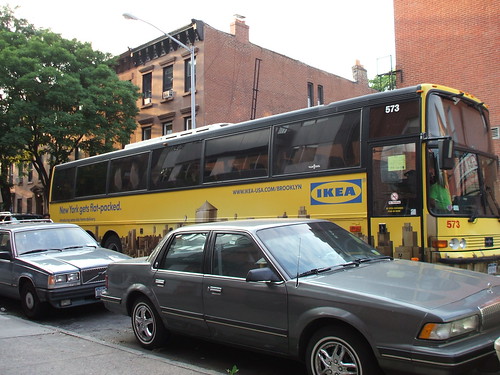
I wish how nice it would be if Nandan or Agora could come up with their branded mini-buses to ferry customers from different locations of the city (or even from outskirts) straight at the doorstep of their respective retail fortresses. If they are wary of the fact that there are too many free-ride lovers in Dhaka city who might take them for a ride by travelling in the vehicle to go to other destinations or disappearing from the entrances, then they can atleast provide free transport (as free love from the brand) to those customers who have just finished shopping and are waiting frustratingly on the streets to convince a CNG or a stubborn yellow cabbie to take them back to their destinations loaded with a whole range of shopping bags. So say for example a bus could run from the Rifle's Square branch of Agora every 30 minutes to cover areas such as Dhanmondi and Mirpur and selected points en route. Similarly another bus can cover the Gulshan branch and areas such as Uttara or even Gazipur. Shoppers who have made a purchase of a minimum amount (say 100 Taka) míght qualify to get on the buses by showing their proof of purchase.


I think the feeling that the brand cares for the customer even after they are done with the shopping is of great importance. Customers without any private vehicles can shop happily and heavily without the anxiety of how to get back home through the horrifying traffic jams of Dhaka city, worse even if the weather is bad too. As their favorite retail shop has air-conditioned mini-buses stand by every half an hour to ferry them for free.


Ikea, the giant world famous retailer of house-hold products provides similar service all around the world to its customers for free and this act of free love from the brand is well appreciated by its customers. As we see branded mini-buses from leading telcos in the city ferrying their employees, we stare and try to see the faces through the tinted glasses of the priveleged employees and wonder how nice it must be to work in those companies. Similarly we will stare at Nandan or Agora branded mini-buses filled with happy customers and keep wondering how nice it must be to shop at those places. Even if the retail shops take you for a ride in terms of product prices, atleast they would offer you a free ride back home with all the shopping. Also, from outside, no one can figure out if the customers had a private car or not, or wearing a lungi or trouser. Provided they let us in in the first place in a lungi, rest can be a happy experience till the end.

Sunday, August 30, 2009

Retail Love: Personalized Receipts

How often do you actually scrutinize the receipt you receive after paying for your essential shoppings at Nandan, Agora, PQS, MeenaBazaar etc.? Chances are very high that not many of us want to read it line by line, as it bears nothing more than the testimony of the payer being poorer at that instance. Was wondering would it make any difference if the malls would consider pepping up the plain and boring act of handing over receipts with statutory texts, legal terms, promotional items etc. by also doing the following.

1. How about asking for name of say every 10th customer and typing it in before printing the receipt. So that the receipt would read, 'Thank you (Asif, Sonia, Rahat) for shopping at Agora with us today'. Will that add a bit of personalization?


2. How about random motivational quotes or 'On this day in history' information on the slips? One might argue that what is the relevance of putting these unrelated information in a receipt? Well that exactly is the point. The objective is to divert buyer's attention to the possibly not so good feeling of becoming poorer by some hundred taka, to something lighter, entertaining and short-living, something which is good as it happens only at the bill counter or at the queue.


3. How about having a webcam installed at every till and targeting customers especially with children to make a pose and smile as the checking clerk pushes the final button for the bills and prints the receipt with a photo icon in it? Its likely that children might find this idea of printing free photos on receipts very exciting and persuade parents to visit that shop everytime, for a reason...or without any...next time.


4. How about asking customers in the receipts to return a collection of say 10 past receipts within 2 months to be able to enter into some sort of lucky draw, free gift voucher or some sort of 'free love' from the retail shop?


5. I am convinced that I suffer from short term memory (ref. Hindi movie Ghajini :) ) as I still have the habit of writing 'things to buy from kacha bajar' in a small piece of paper mixing Bangla and English as my preparatory work. I must admit that I still don't know the names of many spices and vegetables in English and I end up writing it in Bangla in my shopping list such as 'hing, jabitri, jaifol, mushurir dal, tej pata etc'. I always mix up between cardamom, cinnamon, cummins etc. and still function better by writing and reading dhonia, jira, gorom moshla, elachi, darchini. How about asking customers if they want the receipt to be printed in Bangla or English? Is it too much of an overhead or are there too many software complications to achieve this? I reckon not.


6. What about Lazz Pharma and bigger medicine retailers printing out random health and care tips on their receipts?


This simple act of doing something new with something as old and as mundane as a shopping receipt might help those pieces of paper from not being trashed through the car window or to the nearest litter bin along the way. Also, since retail shopping has become more of an experience worthwhile, so there is no harm in giving customers new experiences through something as small as a receipt.


Thursday, August 27, 2009

Renaming Customer Services Department

Recently I upgraded my service with Virgin Media by adding a basic TV package on top of existing broadband and telephone facilities. The sales team called me up a week prior installation to congratulate me for 'making the right decision' and for showing my increasing loyalty with the company. They promised me to offer special deals in near future as I have shown signs of a happy and need-oriented customer etc. etc. etc. So far so good, I hung up the phone and decided to wait for the TV package to arrive in due time.


In the following days, however, I had to make some urgent phone calls back to Bangladesh straight from my landline. I was aware of the bills but the circumstances were such that it was justified and there was no other way. My justifications were faced with a surprise shock after 3 days, now from the Collection department of Virgin Media. They first confirmed if I had made the international calls or not, then they urged me to pay 56 pounds immediately, otherwise they said they would block my telephone services! I was at my wit's end aruging with them why would I pay that amount without receiving any bill in the first place. I was frustatingly disputing the fact that it was not even a week that I proved my 'loyalty' by upgrading my service from them and here they were threatening me to block my other services! What a contrast from the same brand. The collection department decided me to hand my call over to the Customer Services Department then and I was greeted by a heavy Midlands accented lady agent.


I was struggling real bad to understand what the lady was saying in the first place, such a heavy accent it was, I was wondering if this was the listening test during my IELTS examination, I would have surely flunked miserably. So I decided to stop the lady and decided to do the talking myself by narrating her my problem. She listened and provided me the most shocking customer service advice possible. She said with her chewing accent that 'since we are a big company, its not possible for us to treat each and every customer based on their loyalty, trends, behaviour etc. I understand that you have decided to upgrade your package from us, however on the issue of the payment of 56 pounds, you will have to pay it, otherwise we will block all your services, as this is our company policy!' I didn't know pretty much what to expect from them after hearing this. I told them finally that I would pay them shit unless they send me a bill and hung up.


First came the individual's email addresses, then came mobile phones and now we have our unique profiles, friend lists in various social media networking websites. How come the companies as big as Virgin Media even think that I, as a customer, have NOT gained the necessary tools such as internet, mobiles, social networks to make my needs unique, thus making me demand individual treatment. Don't they realise that consumers who used to do 'word of mouth' earlier can very easily do 'word of mouse' with just a click and spread the good word or the bad word faster than a Tsunami? I guess its high time that companies consider renaming their Customer Services Department to 'Individual Services Department' as I am not a generic customer/consumer anymore, I am an individual, I have an identity and I hold some sort of power to convince my network of peers/consumers positively or negatively about any brand these days. You can do the same.

Wednesday, August 19, 2009

Lets change roles for a day or two

On the founding day of the school each year something interesting used to happen. Senior bhaiyas and apus used to volunteer to take up roles of various regular teachers in our classes and attempted to teach us regular subjects such as maths, Bengali, science etc. They wore white aprons, as usually worn by teachers and put their name badges as well, to make it look like more professional and real. We used to thoroughly enjoy this welcome change and we knew that the 'one day teachers' also loved this change of role atleast for a day. They realised how tough it was to manage a class of some odd 40 restless, shouting, screaming pupils and at the same time educate them on basic principles of numbers, nature and life around us. They must have also realised how rewarding the feeling might be to in the teacher's shoes for a day and to gain that authority and respect from a full packed class of juniors. Time passed by, but the principles remain same I guess. And that made me ask today if any Bangladeshi company has this culture of role changing from time to time for atleast a day sometime in the year?


Does it ever happen that you walk into the Grameen Phone Customer Service Center say in Gulshan-2 or in Bashundhara City and see Oddvar Bhai (GP CEO) at the counter serving day to day customers? How about coming across Mamun Rashid uncle at the Citibank reception for a day? I guess Rubaba apa could pretty well try being a call center agent for a day and figure out herself how challenging or rewarding being a female call center agent might be, especially if she greets the caller by saying 'Grameenphoney apnake shagotom, ami Rubaba bolchi, bolun apnake kibhabe sheba ditey pari?'. Similarly I guess it must be a good feeling when Akku Choudhury approaches your table at Pizza Hut and asks you how the pizza was or attempts to take your order himself. How about Doma mama (Banglalink CEO) being one of the tea boys for a day in Banglalink and running around kitchens and floors of Banglalink to serve foot-formayesh from other sirs, madams, bhaiyas and afas.


I guess many of our corporate high-ups become too firewalled by their knowledge, busy schedules and ornamental designations that they fall prey to being isolated from lower or mid ranked employees. If the so called intellectual untouchables sometimes perform these corporate stunts once in a while, it does create an impact atleast to new employees to some extent. In the end of the day, all should realise that the person is never greater than the work itself. So there is no harm in finding out how it feels in each other's shoes. And for us simple consumers, its a delight for a day to know that these think-tanks of companies are, far and foremost, meant to serve us only, they have a primary role to serve and interact directly with ordinary consumers from time to time, along with their usual routines of closed door high profile meetings and hotel parties and foreign trips and giving lectures on business management around universities.


It would be nice to know examples of this happening already in Bangladeshi companies. If it does happen in where you work, share it with us here. There might be examples there for others to follow. Lets wear the teacher's apron for a day, lets get to know how a big company is run with apparently small but important roles played by staff who you don't meet perhaps in years. Lets do the job wearing their hat for a day or two.

Tuesday, August 11, 2009

Hope Win wins! Hope Agriculture wins!

I guess it was back in 1994 when Agricultural Science was introduced as an elective subject for SSC examinations in Bangladesh. I, along with my rebel and restless classmates, remember raising eyebrows and teasing the fact that we will have to learn now how to cultivate land and milk cows! 15 years is not a short time, but if I remember clearly, boys were supposed to study Agri Science while our 'homely' female classmates were seen heading for the Home Science subjects. They were supposed to grow up to be specialists in cooking tasty food, sewing baby clothes and manage overall households. Whereas we, were supposed to invest a significant portion of our knowledge, time and expertise in agriculture of Bangladesh when we grow up. We were I guess too young to realise then that Agricultural Science was more than just another subject to clear in SSC, rather it was the science about the very backbone of Bangladesh's economy, its existence. I hated to learn about the symptoms of ranikhet disease of poultry and we had a good laugh when a truant gangmate boasted off drawing an image of milking a cow in the exam paper. I don't remember any of us ever wanted to become educated farmers or even venture anywhere near the agricultural services, produces or any related area when we grow up. Such was our allergy, such was our notion, such was our prejudice.


Its certainly an eye opener that there are still innovative entrepreneurs who are showing the way not only to young generation but to other entrepreneurs as well...the value and merit of agriculture related businesses, startups and services in Bangladesh. Win Inc. is one of such companies who has invested their interest and expertise in collecting, collating, validating, digitising and distributing latest, timely and tested information on agriculture, fishery, poultry, livestock covering more than 80 items...all in Bangla. They have set up an impressive collection of this knowledge at www.ruralinfobd.com which can be termed as the digital gateway to agri-information in Bangla. The company also works as the content generator for agri-information to be collected and used by rural farmers, through the Community Information Centers of Grameen Phone, all around the country. They are also providing information to Banglalink's 7676 Jiggasha helpline, which is an agri-call center. Such noble has been the companies dedication towards this line of business that they have recently been nominated for an award in the e-agriculture category in the eIndia 2009 conference in India. Would be a good gesture to vote for Win, who are showing how agri information in Bangla can not only be a successful business model but also has the ability to serve numerous farmers of Bangladesh by providing them with timely and accurate information on their crops, livestocks, etc.


I still remember attending Agricultural Science classes in school and think it was a great opportunity wasted. Seeing companies like Win Inc. making sense out of this is a great learning and realisation too. I am sure we needed to hone our skills and knowledge with something that is more relevant in the context of Bangladesh. Agriculture that is. Hope Win wins in eIndia and in every other venture.

Tuesday, August 4, 2009

In case of emergency, cut rope

A topic gathering enough interest lately is that of Generation G. To add to the ongoing conversations about charity, corporate social responsibility, consumers are also expecting companies to be generous through different ways.


Aircel, an Indian mobile operator took advantage of nature's adversity during monsoon rains in Mumbai and showed brand love and generousity to its customers by putting up a real inflated boat on a billboard, tied it with ropes and printed 'In case of emergency, cut rope'. I think this is a great example which proves that companies need to move beyond creating branded bus stops around cities, branding traffic islands, putting up their advertisements in virtually every single eye-space available and rather do something really innovative, keeping in view the local context, or even the natural phenomenon i.e. monsoon, floods, in this case. Similarly acts of distributing blankets during winter to poor people, arranging free eye clinics etc. are all tried and well received from time to time to show the caring side of the brand. But how many times does it actually makes the connection with the consumer and how long does the customer value that connection? As the idiom goes 'A friend in need is a friend indeed', consumers would rely on those brands only who stood next to them during bad times, hour of need and emergency.

Monday, August 3, 2009

World’s largest marketing Communications Agencies Network ComVort ties up with Bangladesh’s Roop

Roop of Bangladesh has recently joined ComVort Group Worldwide, a powerful alliance of the world's largest and leading independent marketing communication agencies network headquartered in Barcelona.

The Group's member agencies 'Work within the marketing-communication branch in almost every metropolis across the globe, ComVort has been ranked as the top global independent agency network by ‘Advertising Age’ (USA), with over 172 offices in 143 cities of 73 countries, 4,300 employees, 5,000 clients and services offered in over 47 languages. Revenue in USD 669,000,000.

The very structure of ComVort characterises the philosophy on which it was established - Think Global, Act Local, which provides for a more competitive and productive advantage over traditional integrated service agencies network.

All ComVort members offer a vast depth of knowledge of the social and cultural makeup of local consumer and marketplace. This, coupled with access to global knowledge base and expertise in diverse communication fields would give Roop, as a ComVort member, the edge to deliver exceptional value to their clients like Pan Pacific Sonargaon Hotel, Banglalink, Lafarge-Surma Cement Ltd, SEDF, Kohinoor Chemical, Cute, Labaid, Dekko Group, BKMEA, Samsung, Thai Trade Centre, Philips etc.

As part of the ComVort Group, Roop Bangladesh can also offer local companies with international business, access to a large network of prompt, efficient and highly involved marketing and advertising agencies in all continents.

Given its strategy to strengthen network in developing markets, both Mr Karl Jacobi, Chairman of ComVort Group and Mr Yusuf Hassan, CEO of Roop Communications, stood committed to the success of its local and international business partners in Bangladesh.